Foodics vs. Oracle Micros vs. Sapaad: The 2026 POS Decision Guide for Dubai Restaurants
Yenta Technology
2026
Best Restaurant POS System Dubai (2026): Foodics vs. Oracle vs. Sapaad
If you are opening a restaurant in Dubai today, you are likely being bombarded by sales calls. There are over 50 Point of Sale (POS) systems competing for your Dirhams, from global giants like Toast (which often struggles in the UAE due to payment processing locks) to local startups that might not exist next year.
The reality? For 90% of serious operators in Dubai—whether you run a cafeteria in Deira, a fine dining spot in DIFC, or a cloud kitchen in Al Quoz-your shortlist realistically comes down to three names: Foodics, Oracle Micros Simphony, and Sapaad.
This guide cuts through the sales brochures to explain exactly which system fits your operational constraints, hidden costs, and growth trajectory.
The Bottom Line (TL;DR)
If you don't have time to read the full analysis, here is the cheat sheet for the Best Restaurant POS System in Dubai:
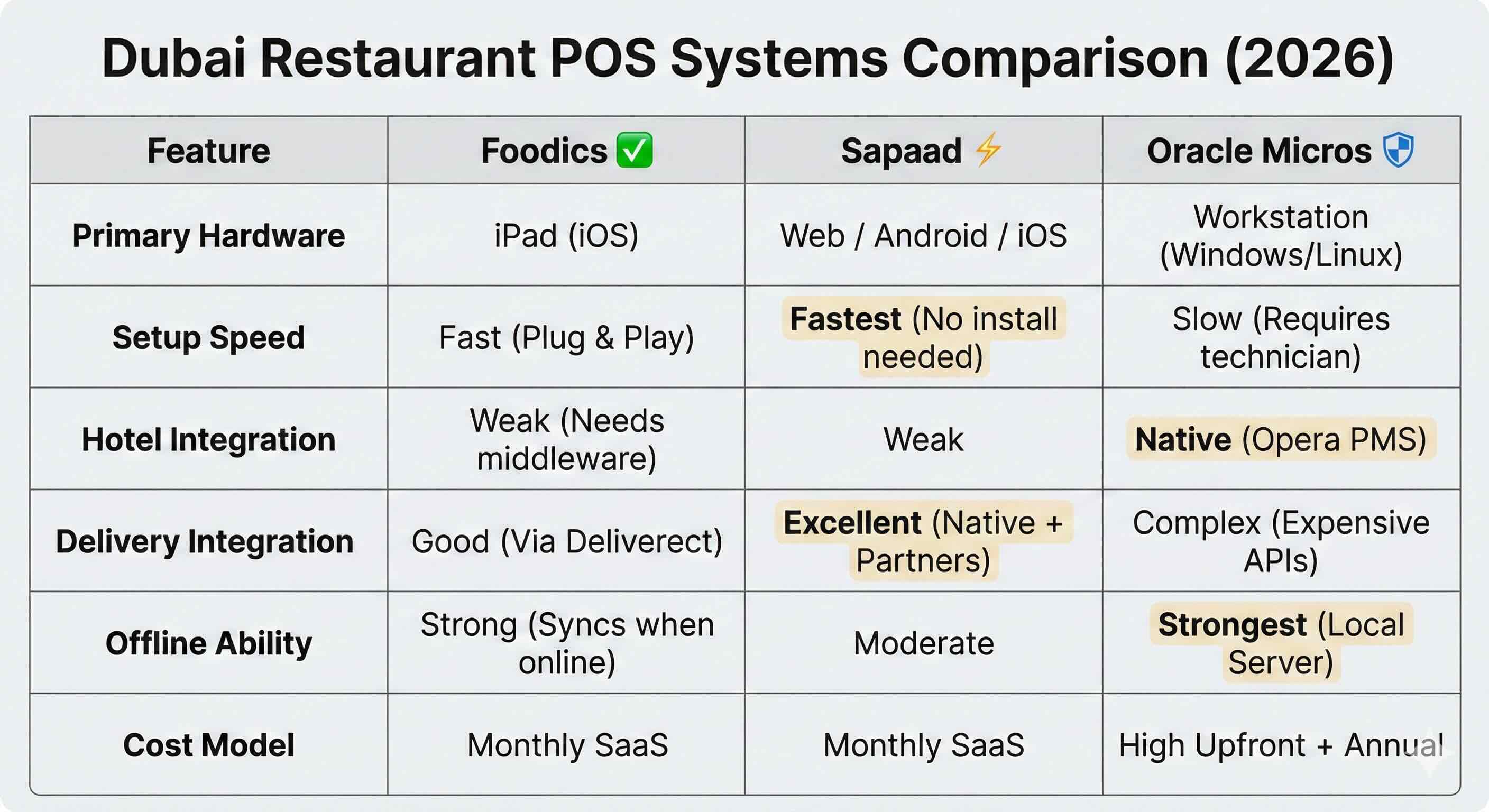
Choose Foodics if: You are a QSR, Cafe, or Local Chain (1–20 branches). It is the region’s "iPhone of POS"-intuitive, handles Arabic/English seamlessly, and offers the smoothest FTA VAT compliance out of the box.
Choose Oracle Micros Simphony if: You are located inside a Hotel or Resort. If you need to post charges to a guest's room (integration with Opera PMS) or manage complex liquor inventory across 10+ outlets, this is the industry standard. It is expensive and clunky, but stable.
Choose Sapaad if: You are a Delivery-First Concept or Cloud Kitchen. Its architecture is built to handle high-volume orders from Talabat/Deliveroo better than the others, and it works on any browser, making it hardware-agnostic.
Part 1: The "Anti-Persona" (Who Should Leave Now?)
Before we debate features, let's disqualify the wrong buyers. If you fall into these categories, these three systems are likely overkill or a mismatch.
1. The "Home Baker" / Pop-Up
If you sell cookies on Instagram and do the occasional pop-up at Ripe Market, do not buy these systems. They have monthly recurring costs that will eat your margins.
Alternative: Use Square or a simple payment link from Stripe or Tabby.
Why: You don't need inventory tracking; you need cash flow.
2. The Retail Store
If you sell abayas, electronics, or perfumes, these systems will frustrate you. They are built for recipes, modifiers, and kitchen printers—not SKUs and sizing matrices.
Alternative: Use Odoo or Shopify POS.
Why: Foodics and Sapaad cannot handle "Size: Small / Color: Red" matrices efficiently.
Part 2: Deep Dive Analysis & Trade-offs
1. Foodics: The Local Champion
Best For: Cafes, Burger Joints, Bakeries, and Dine-in Restaurants.
Foodics is the dominant player in Saudi Arabia and the UAE for a reason. It was built specifically for the GCC market, meaning it solves local problems that US-based systems ignore.
The Good
Localization: It handles "Arabizi" (Arabic/English) better than any competitor. Kitchen tickets can print in Arabic for kitchen staff while the receipt prints in English for the guest.
Foodics Pay: Their integrated payment terminal is a game-changer for speed. The cashier pushes the amount on the iPad, and the card machine lights up automatically. This eliminates the "double entry" error where a cashier types 5.00 AED instead of 50.00 AED.
Inventory: The "Shelf-to-Sheet" mobile app allows staff to do stocktakes on their phone.
The Bad
Price Creep: While the base tier is affordable (~199 AED/mo), costs stack up. If you want the API to connect to Talabat, that’s extra. If you want advanced inventory, that’s extra.
Support Saturation: As they have scaled massively, some users report that reaching a human for technical support during a Friday night rush has become slower than it was in previous years.
2. Oracle Micros Simphony: The Enterprise Standard
Best For: Hotels (Marriott, Atlantis, etc.), Large Franchises, and Fine Dining with Liquor Licenses.
Micros is the "IBM" of the restaurant world. It is not pretty, and it is not cheap, but it is impossible to kill.
The Good
PMS Integration: This is its "moat." If you are in a hotel, you need to let guests "charge to the room." Micros integrates natively with Opera (the hotel software). Foodics and Sapaad often require messy workarounds to do this.
Granularity: You can configure it to do almost anything. Want a specific steak to print to the grill printer only if it's medium-rare? Micros can do that.
Hardware Durability: The Micros workstations are tanks. They can survive grease, heat, and spills that would destroy an iPad.
The Bad
The Cost: You aren't just paying for software; you are paying for proprietary hardware, installation fees, and mandatory support contracts. A 3-terminal setup can easily cost 50,000+ AED upfront.
The "Legacy" UI: The backend looks like Windows 95. Training Gen Z staff to use it takes twice as long as training them on an iPad system.
3. Sapaad: The Delivery Specialist
Best For: Cloud Kitchens, Pizzerias, and Multi-Brand Delivery Concepts.
Sapaad differentiates itself by being "browser-based." You don't need an iPad app; you can run it on Chrome on any laptop, Android tablet, or phone.
The Good
Delivery Architecture: Sapaad was one of the first to build a dedicated "Delivery Manager" screen. It tracks the rider from the moment they leave to the moment they return.
Cloud Kitchen Friendly: If you run 5 brands (Burgers, Wings, Salads) out of one kitchen, Sapaad handles the toggling between brands seamlessly.
Hardware Agnostic: Because it runs in a browser, you can buy cheap Android tablets instead of expensive iPads. This saves thousands in startup costs.
The Bad
Offline Mode: Because it is browser-heavy, its offline capabilities are sometimes less robust than Foodics (which stores data locally on the iPad app). If your internet in Business Bay cuts out, Sapaad can struggle.
Aesthetics: The interface is functional but "engineer-designed." It lacks the polish and beauty of Foodics' UI.
Part 3: The Comparison Matrix
Part 4: Buyer Scenarios (Decision Frameworks)
Scenario A: The "Local Hero" Cafe
Context: You are opening a specialty coffee shop in Jumeirah. You have 4 staff members and want to sell merchandise (beans/mugs) alongside coffee.
The Decision:Buy Foodics.
Why? You need a counter-top display that looks sleek (Apple aesthetic matches specialty coffee). You need "modifiers" (Oat milk, sugar-free, extra hot) to be fast and accurate. Foodics handles retail items (coffee bags) decently well for a restaurant POS.
Scenario B: The Hotel F&B Director
Context: You manage the F&B for a 5-star hotel in Palm Jumeirah. You have 6 outlets, including a pool bar and a steakhouse.
The Decision:Stick with Oracle Micros.
Why? Your finance team will demand that all revenue flows into the main hotel ledger. If a VIP guest complains about a charge at checkout, the front desk needs to see the signed check immediately. Only Micros provides this level of data unification across property management and point of sale.
Scenario C: The "Ghost Kitchen" Entrepreneur
Context: You are renting a kitchen in a dark store facility. You have no waiters, no tables, and no cash. You exist only on Talabat and Noon.
The Decision:Buy Sapaad.
Why? You don't need a pretty guest-facing screen. You need a "Kitchen Display System" (KDS) that aggregates orders from 4 different aggregators into one screen. Sapaad’s "Live Monitor" gives you the best visibility on prep times vs. driver arrival times.
Part 5: The "Integration Lie" (Read Before You Sign)
Every salesperson from all three companies will tell you: "Yes, we integrate with Talabat, Deliveroo, and Careem."
Here is the truth:
Direct integrations often break. Aggregators update their APIs constantly. If the direct link breaks on a Thursday night, you lose orders.
The Professional Solution:
Smart operators in Dubai do not rely on the POS direct integration. They budget for Middleware (like Deliverect or UrbanPiper).
What it does: It acts as a bridge. Talabat talks to Deliverect -> Deliverect talks to your POS.
The Cost: Approx. 300–500 AED/month.
Is it worth it? Yes. It eliminates the "Tablet Hell" of having 5 different ringing tablets on your counter. It injects the order directly into your Kitchen Printer. Both Foodics and Sapaad work beautifully with Deliverect. Micros requires expensive licenses to allow this connection.
Part 6: FTA & VAT Compliance in Dubai
Since 2018, the UAE has enforced a 5% VAT. The Federal Tax Authority (FTA) has strict requirements for tax invoices.
Foodics: Updates automatically with FTA regulations. If the government changes the format of the "Tax Invoice" tomorrow, Foodics pushes an update to your iPad instantly.
Sapaad: Also highly compliant and quick to update.
Oracle Micros: Because it is often server-based, updating tax rules can sometimes require a paid visit from a technician or a complex patch installation.
Warning: Do not buy a POS from the US or Europe that does not officially support "UAE VAT." If your receipt does not show the TRN (Tax Registration Number) clearly, you can be fined per invoice.
Final Verdict: 2026 Forecast
The market is shifting.
Foodics is becoming the "Standard" for independent businesses, slowly eating away at the market share of older legacy systems.
Sapaad remains the king of efficiency for delivery-heavy models.
Oracle Micros is holding onto the enterprise/hotel sector, but losing ground in standalone fine dining.
Your Next Step:
Before signing a contract, ask for a "Menu Build Demo." Send them your PDF menu and ask them to build 5 complex items live in front of you. If it takes them 20 minutes to add a "Lunch Special with 3 choices," walk away. Speed of configuration is the best proxy for how easy the system will be to live with.
A Word from Your Honest Broker
We've analyzed the specs, the costs, and the integrations. But at the end of the day, this is a relationship, not just a transaction.
So listen to me, darling: stop looking for a system that promises you the moon and stars on a first date—marry the steady one that actually picks up the phone when the kitchen printer jams on a Friday night, and leave the drama for your competitors.
This is where Yenta gets intimate with your taste. Every search, craving, and late-night scroll trains the AI to move with you — smarter, sharper, and more instinctive with every chat.
Machine-learned recommendations that feel made for you
A living profile of your moods, habits, and hidden preferences
Trend signals that help Yenta predict what you’ll want next — before you ask